


ATTRACTIONS x Hasami Ware A20033W Skull Mug White Skull Mug Ceramic
ATTRACTIONS x Hasami Ware A20033W Skull Mug White Skull Mug Ceramic
Low stock
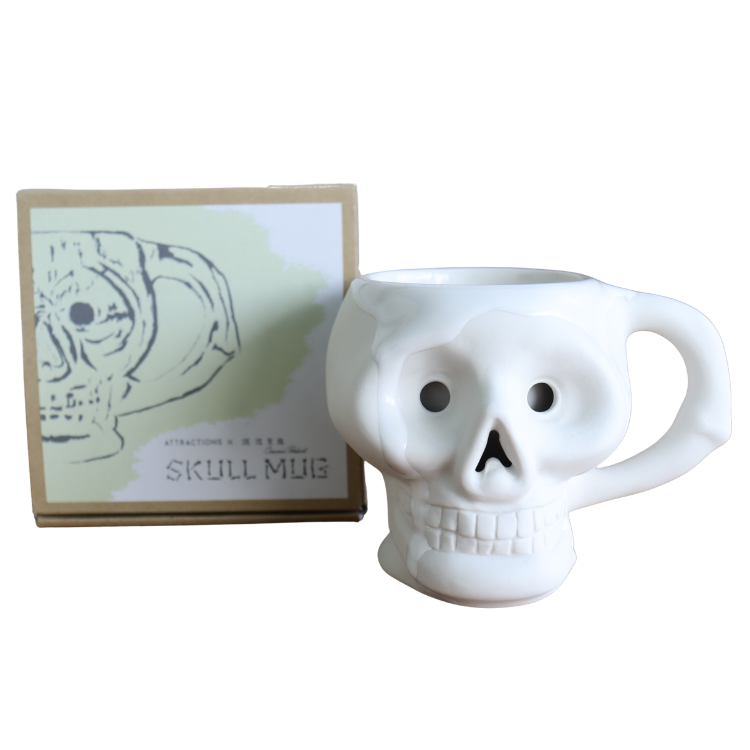
The third installment of the Hasami ware skull mug series.
This time, too, a limited edition white & white coloring.
A ceramic product developed through our own research and development, based on a vintage skull mug with a rare structure, produced in Japan for export to the US from the 1950s.
It was completed after more than three years of trial and error, with the cooperation of Kikushou Touki, a Hasami ware kiln.
Its unique expression and special double-layered structure are still extremely difficult to mass-produce today, demonstrating the high level of Japanese craftsmanship 70 years ago.
Porcelain, made from pottery stone, is used.
In contrast to pottery, which is made from clay and called "tsuchimono" (earthenware), porcelain is made from stone and called "ishimono" (stoneware). It is the hardest of all ceramics and is characterized by its non-absorbent nature.
Its beauty, as transparent as glass, and its hard, smooth texture are captivating.
MOLDING & SHAPING
Forming the body.
Pouring slip, the raw material for porcelain, into plaster molds and rotating it on a turntable to remove excess slip.
DEWATERING & BISCUITFIRING
Bisque firing is the process of firing at a low temperature of around 800 degrees Celsius to give the body a certain degree of strength and prevent excessive shrinkage during the main firing.
To prevent cracks and breakage, the body is thoroughly dried for a long time before bisque firing.
GLAZING & GLOST FIRING
Dipping in glaze, which vitrifies with heat, increases water resistance after firing and creates a translucent luster characteristic of porcelain.
Since porcelain clay contains many components that change into heat-resistant glass, the main firing is carried out for a long time using a reduction firing method that reaches high temperatures of 1300 degrees Celsius or more.
FIRING
Bisque firing, main firing, and overglaze firing each require different kiln temperature adjustments and firing times, thus demanding years of experience, concentration, and endurance at high temperatures.
It is a harsh and delicate task unique to a kiln.
One of the interesting aspects of this product is that each one has a different pattern after firing, making it an excellent item for display when arranged in multiples.
H : 10 (cm)
Porcelain
Made in Japan
Couldn't load pickup availability


- 8,800円以上で送料無料
- 15時までのご注文は原則当日発送
- ジーンズの裾上げ無料
配送・送料について
本州・四国・九州:ご注文金額8,800円未満の場合は送料660円、 8,800円以上で送料無料。
北海道・沖縄は購入金額に関わらず送料1,100円。
15時までにいただいたご注文は、定休日・土日祝日・一部の前払い決済を除き、 原則として当日発送いたします。
お支払い方法
クレジットカード、Shop Pay、PayPay、コンビニ払い、 銀行振込をご利用いただけます。
裾上げ・洗いについて
ジーンズの裾上げは無料です。 ご希望の場合はカートの備考欄にご希望の股下をご記入ください。 (例:裾上げ希望 股下〇〇cm)
未洗いのジーンズは、無料の洗い・糊落とし後に裾上げすることも可能です。 洗い後の縮みや裾上げの長さで迷われる場合は、 ご注文前にチャットからご相談ください。
※裾上げ・洗い加工後の商品は、返品・サイズ交換をお受けできません。
